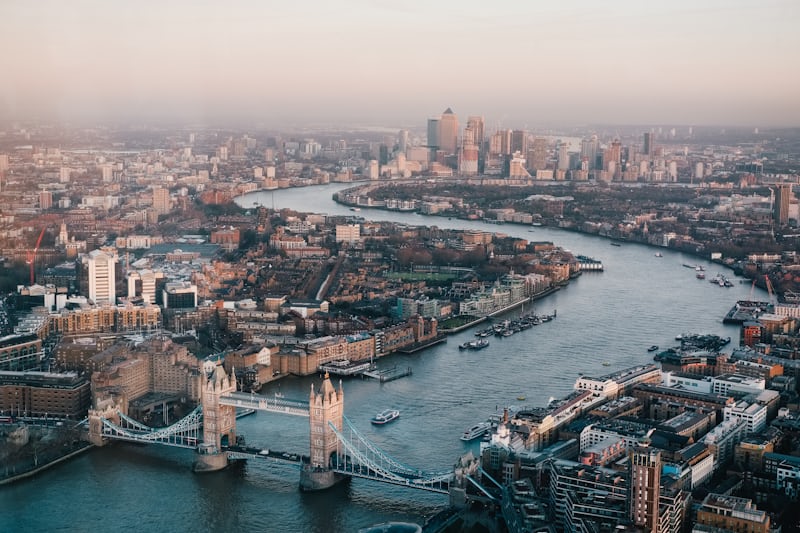
If you're visiting the UK, the taxi system takes about two minutes to understand — and getting it wrong can put you in an uninsured car. Here's everything you need: the options, how to pay, whether to tip, and the single safety rule that matters more than everything else combined.
Key takeaways
- Black cab: hail it or take it from a rank. Metered. No booking needed.
- Minicab / app: must be pre-booked. Fare agreed or app-calculated.
- Payment: card and contactless accepted everywhere; cash still works.
- Tipping: optional, modest — rounding up is normal.
- The one rule: never accept a ride from someone who approaches you.
01 / OPTIONSYour three options
The black cab (taxi). The iconic London cab, and hackney carriages elsewhere. You can hail it in the street (if the yellow “TAXI” light is on) or take it from a rank. It runs on a meter. No booking. The driver has passed the Knowledge and will genuinely know where he's going.
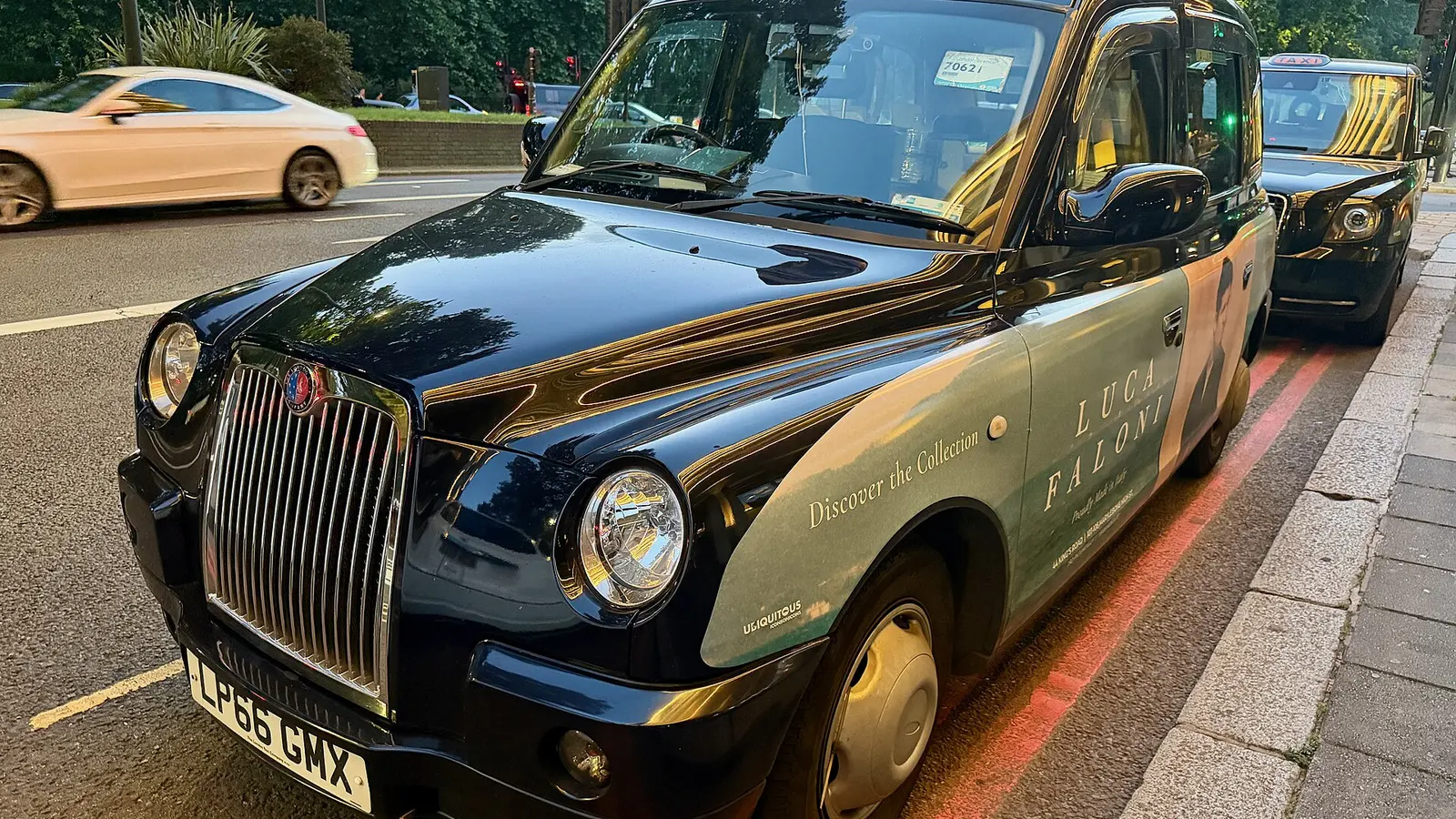
The minicab (private hire). Must be pre-booked through a licensed operator — by phone, website or app. The fare is usually agreed in advance. You cannot hail one.
The apps. Legally these are minicabs — tapping the app is the booking. Convenient, but the price is dynamic, so it rises when demand does.
02 / RULEThe one rule that matters
Never accept a ride from anyone who approaches you. Not at the airport, not outside a station, not outside a nightclub. In Britain, legitimate taxis do not tout for business — they wait at ranks, or they arrive on a booking. A person walking up to you offering a car is breaking the law, and their vehicle is almost certainly not insured to carry you.
This is the thing to know as a visitor. Everything else is convenience; this is safety.
03 / AIRPORTAt the airport
Three legitimate routes: the official taxi rank (follow the “Taxis” signs — metered, you queue); a pre-booked car (the driver meets you inside arrivals with a board showing your name — no queue, no walk); or an app (which at Heathrow means walking to a car park zone, several minutes away with your luggage).
For a first arrival in an unfamiliar country, tired and carrying bags, being met inside the terminal by a named driver is by some distance the easiest of the three.
04 / PAYPaying and tipping
Payment. London black cabs are required to accept card and contactless, and most minicabs do too. Cash is still accepted widely. Apps and pre-booked operators typically charge a saved card or let you pay in advance.
Tipping. Modest and optional — nothing like the US expectation. Rounding up to the nearest pound, or roughly 10% for a long journey or genuinely good service, is normal and appreciated. Nobody will be offended if you don't.
05 / RUSHXOThe easy option for arrivals
For a visitor landing in the UK, a pre-booked fixed-fare transfer removes every uncertainty at once: a price agreed before you fly (in your own currency, on your own card), a named driver waiting inside arrivals, your live traffic routing so a delay doesn't strand you, and no negotiation, no meter and no touts. It is the calmest possible way to arrive in a country you don't know.
Do I need an Oyster card or can I just tap my bank card?
A common question from visitors is whether they need to buy an Oyster card at all. For most adults in 2026 the answer is no. A contactless bank card, or a phone or watch with Apple Pay or Google Pay, works on the Tube, buses, DLR, Overground, Elizabeth line and most National Rail services in London. You pay the same pay-as-you-go fares and get the same daily caps as Oyster.
- Contactless card or phone: nothing to buy. Tap the yellow reader at the start and end of every Tube or rail journey, and once when you board a bus. A zone 1 Tube journey costs £3.10 peak or £3.00 off-peak, and travel in zones 1-2 is capped at £8.90 a day.
- Visitor Oyster card: ordered before you travel, with a non-refundable £10.50 card fee on top of the credit. It mainly helps if your bank charges a fee on every foreign transaction, or if you have children aged 11 to 15 who need the Young Visitor discount.
Visa, Mastercard and American Express generally work, but some non-UK cards don't, so carry a backup.
If you'd rather skip readers and zones on arrival day, a pre-booked car at a fixed fare agreed at booking takes you to the door, from about £93 in a saloon to central London.
Q: Is Oyster cheaper than contactless in London?
A: No. Adult pay-as-you-go fares and daily caps are the same on Oyster and contactless. A Visitor Oyster card also carries a £10.50 card fee, so for most adults contactless works out cheaper.
Q: Do I need to buy anything before I arrive in London?
A: Not if you have a contactless card that works abroad without high fees. Just tap in and out with it. A Visitor Oyster card is optional and mostly useful for families with 11 to 15 year olds.
Can two people share one contactless card or phone?
A common question from couples is whether they can tap the same card twice at the gate. They can't. Each traveller needs their own card or device for every journey. The system tracks journeys by card, so a second tap on the same card is not a second fare for a second person. At best the gate stays shut. At worst you get incomplete journeys and maximum fares.
Simple ways round it:
- Two physical cards: ask your bank for a second card on the same account before you travel.
- One card, one phone: a card and a phone wallet count as separate devices. One person taps the plastic card, the other taps a phone with a different card loaded. Each gets their own cap.
- A Visitor Oyster card for the second person.
Whatever you choose, always tap out with the same card or device you tapped in with. Keep cards apart in your wallet so the reader doesn't pick up the wrong one (known as card clash). Check your journey history afterwards if a charge looks odd.
For a family or group arriving with luggage, a pre-booked car is simpler: the fare is fixed when you book, so there are no per-person taps or caps to track.
Q: What happens if we both tap the same card?
A: The second tap is treated as the same person, so the gate may not open or you can end up with incomplete journeys charged at the maximum fare. Each person needs their own card or device.
Does Apple Pay or Google Pay work on the Tube?
Yes. Phones and smartwatches with Apple Pay or Google Pay work on every reader where a contactless card does, at the same fares and caps. A common worry from visitors is what happens with Face ID, a weak battery or a watch. Here is how it works in practice.
- Express Mode on iPhone and Apple Watch: set one card as your Express Transit card in Wallet. You can then tap without Face ID, Touch ID or a passcode.
- Low battery: on iPhone XS and later, Express Mode keeps working for up to five hours after the phone shows the power reserve warning. Older phones need to be switched on.
- Android: make sure NFC is on and your card is set up in Google Wallet before you leave home.
- Same device in and out: your phone and your watch count as two different devices, even with the same card. Tap in with the phone and out with the watch and you get two incomplete journeys.
Keep the plastic card as a backup in case your phone dies, but don't tap with it mid-journey.
If you land late with a flat phone, a pre-booked car with flight tracking and 60 minutes' free waiting means the driver is already there and you don't need your phone to pay at the gate.
Q: Can I tap in with my phone and out with my watch?
A: No. They count as two separate devices, so you would be charged for two incomplete journeys. Use the same device for the whole journey.
Q: What if my iPhone battery dies on the Tube?
A: With Express Mode on an iPhone XS or later, you can still tap for up to five hours after the power reserve warning appears. On older phones, carry the physical card as a backup.
Will my foreign card charge a fee every time I tap?
Visitors from the US and elsewhere often ask whether each Tube tap means a separate foreign transaction fee. Usually not. TfL does not take money at every gate. It adds up your journeys and charges your card in one go after the travel day, which keeps the number of transactions low. Daily capping also limits the total.
What decides the cost is your own bank:
- Percentage fee: many cards add a foreign transaction fee to every charge. On a few pounds of Tube travel this is small, but it adds up across a trip.
- Fixed fee per transaction: some debit cards charge a set amount each time. These are the cards to avoid for transport.
- Fee-free travel cards: many US credit cards and travel debit cards have no foreign transaction fee. Use one of these for tapping.
Also check your card is accepted. Visa, Mastercard and American Express generally work, but some non-UK cards do not. If your bank charges heavily, a Visitor Oyster card topped up in advance avoids per-charge fees, though it has a £10.50 card fee.
For the airport leg, a pre-booked car is one fixed fare agreed at booking, so you see a single charge rather than several.
Q: Does TfL charge my card every time I go through the gates?
A: No. TfL usually groups a day's journeys into one charge after you finish travelling. Any foreign transaction fee then depends on your own bank.
How do the 2-for-1 attraction offers work with a Travelcard?
Visitors often ask how to get the National Rail 2-for-1 deals on attractions. The offers run through the Days Out Guide scheme. You download a voucher and show it with a valid National Rail ticket for that day.
- What counts: National Rail tickets, including a Day Travelcard bought from a National Rail station or ticket machine.
- What doesn't: Oyster, contactless and tickets bought at London Underground stations.
- 2026 Day Travelcard prices: Anytime zones 1-4 £16.60, Anytime zones 1-6 £23.60, Off-peak zones 1-6 £16.60.
Do the maths first. Tapping contactless in zones 1-2 is capped at £8.90 a day, so a Travelcard costs you extra. It only pays off when the 2-for-1 saving on a paid attraction is bigger than that difference. Two adults visiting one big paid sight on the same day is the typical case where it works.
TfL consulted on withdrawing the paper Day Travelcard in 2023. It is still on the 2026 fares list, but check the Days Out Guide and National Rail before you rely on it.
If you are heading out with older relatives or lots of bags, a pre-booked car at a fixed fare agreed at booking can take the stress out of the trip to and from your hotel.
Q: Can I get 2-for-1 attraction entry with contactless?
A: No. The Days Out Guide offers need a valid National Rail ticket, such as a Day Travelcard bought from a National Rail station. Oyster and contactless don't qualify.
FAQFrequently asked questions
How do taxis work in the UK?
Black cabs (taxis) can be hailed in the street or taken from a rank and run on a meter. Minicabs (private hire) and apps must be pre-booked, with the fare agreed in advance or calculated by the app. You cannot hail a minicab.
What is the most important safety rule for taxis in the UK?
Never accept a ride from someone who approaches you — at an airport, station or club. Legitimate UK taxis never tout for business; they wait at ranks or arrive on a booking. Anyone approaching you is breaking the law and is almost certainly uninsured to carry you.
Do UK taxis take card?
Yes — London black cabs are required to accept card and contactless payment, and most minicabs do too. Cash is still widely accepted, and pre-booked operators typically let you pay in advance or on account.
Should I tip a taxi driver in the UK?
Tipping is modest and optional — nothing like the US expectation. Rounding up to the nearest pound, or around 10% for a long journey or particularly good service, is normal. Nobody will be offended if you don't tip.
What's the easiest way to get from the airport as a visitor?
A pre-booked transfer — the driver meets you inside arrivals with a board showing your name, the price is agreed before you fly, and your flight is tracked. No queue, no car park walk and no negotiation in an unfamiliar country.
Can I hail a minicab or an Uber in the street?
No — only taxis (black cabs) can be hailed. Private hire vehicles, including app cars, must be pre-booked. Flagging one down isn't legal and isn't safe.
Time Matters
Arrive the easy way — book ahead
Fixed fares confirmed before you ride. Local licensed drivers, live traffic routing, 24/7 human support — and no surge, ever.