AOG Courier London City Airport Taxi – Fixed Price Quote, Book Online 24/7

London City is the most constrained major airport in the country — a single short runway, a tight apron, and no base maintenance capability on site. That makes an AOG here a race against the turnaround, and the part almost always has to come from somewhere else.
Dispatch is staffed around the clock, including nights, weekends and public holidays.
Why an AOG at London City is not like an AOG anywhere else
London City sits inside London, on the old King George V Dock in the Royal Docks. Its physical constraints shape everything about how an AOG plays out there.
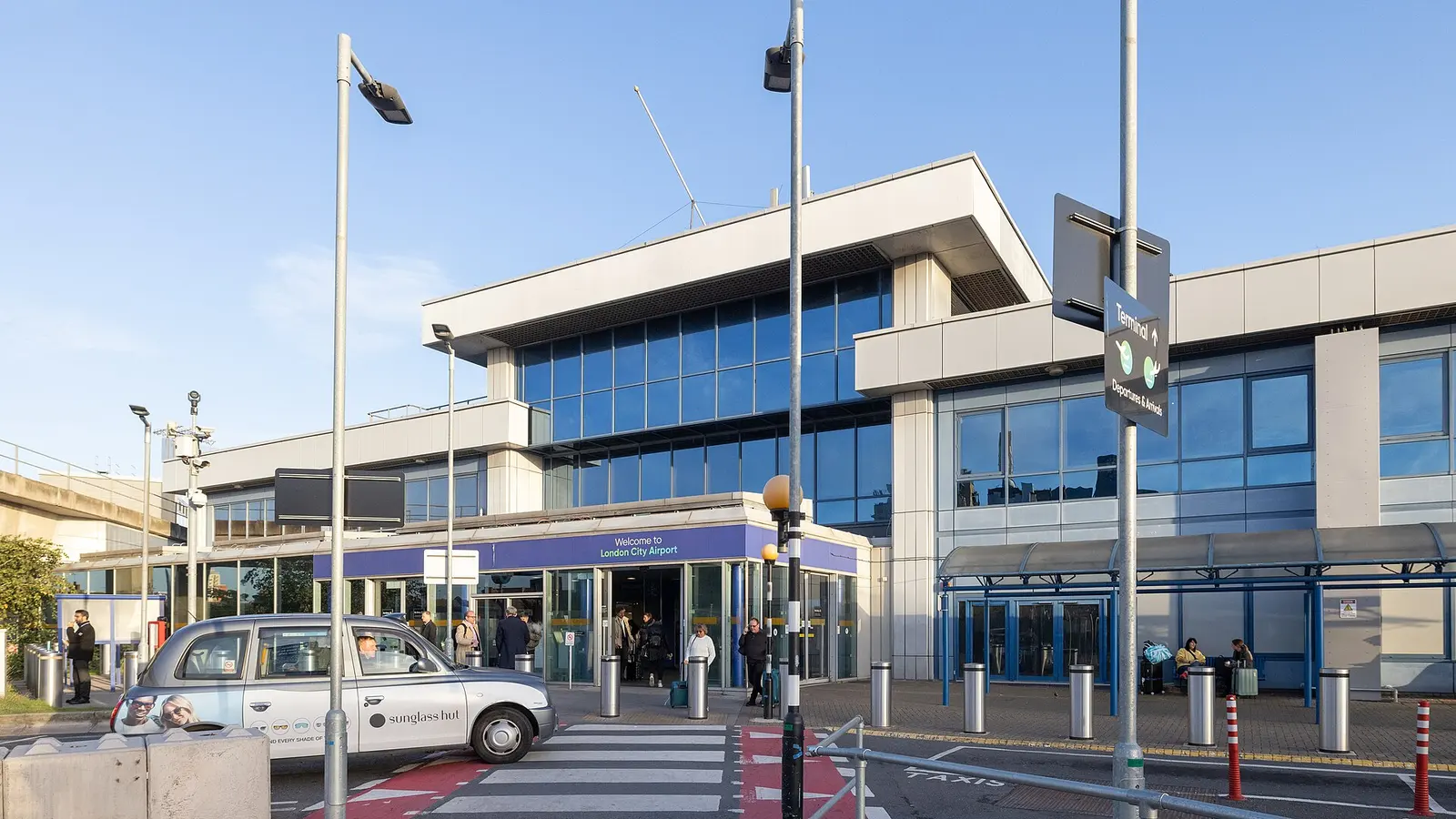
| A single, short runway | Roughly 1,500m with a steep approach, so only specific certified aircraft types operate — predominantly Embraer E-Jets and the Airbus A220 |
|---|---|
| A physically tight site | Hemmed in by water and city on all sides, with limited apron and no room to leave an unserviceable aircraft parked indefinitely |
| No base maintenance on the airfield | Heavy maintenance is not carried out at LCY. Operators use hangars elsewhere — BA CityFlyer, the largest based operator, sends airframes off-site for base maintenance |
| Restricted operating hours | Noise controls mean the airport does not run through the night, which compresses the window for a fix |
| Short, dense turnarounds | The schedule is built on quick rotations. There is little slack in the day to absorb a delay |
What this means when an aircraft goes tech here
Because there is no hangar to retreat to, the pressure at LCY sits on the turnaround itself.
| What is at stake | Why it is sharper at LCY |
|---|---|
| Apron space | A constrained apron means an unserviceable aircraft occupies a stand others need |
| The rotation | Short sectors and quick turnarounds mean one delay cascades through the day quickly |
| Operating hours | Restricted hours cap how late a fix can realistically be completed and the aircraft still depart |
| Crew duty | Multi-sector days against fixed limits — a long delay can end the duty even after a fix |
| Slots | Time-bound, and at a slot-constrained airport not easily recovered |
| Positioning | If the aircraft has to go elsewhere for repair, the whole day's programme is rebuilt |
The transport question at LCY is unusually simple to state: can the part be here before the window closes? If yes, the aircraft stays in the programme. If no, the recovery is a much larger and more expensive exercise.
Where we collect from for London City jobs
| Operators' engineering stores | Central spares holdings at the operator's main base |
|---|---|
| Line maintenance providers | Bases and stations elsewhere holding the required unit |
| Parts suppliers & distributors | Aviation stockists and exchange pools anywhere in the UK |
| Cargo terminals | Imported spares released at Heathrow or another cargo centre — see Heathrow cargo collection |
| Component workshops | Avionics benches and overhaul shops returning serviceable units |
| Other airports | Road movements from airfields nationwide |
Note the pattern: almost every LCY delivery originates somewhere else. Unlike Farnborough or Biggin Hill, there is no substantial on-field parts holding to draw on, which is why inbound road movements dominate the work here.
What we carry
| Aircraft spare parts | Rotables, line-replaceable units, structural and cabin components |
|---|---|
| Avionics | Flight deck and navigation units, sensitive electronic assemblies |
| Tyres & wheels | Main and nose gear wheel assemblies |
| Brakes | Brake units and associated components |
| Engine parts | Components, modules and accessories, subject to size and lifting arrangements |
| Tooling | Specialist and calibrated tooling, torque equipment |
| Ground equipment | Jigs, fixtures, test and support equipment |
| Documentation | Release certificates and technical records, carried with the part |
Dangerous goods: lithium batteries, oxygen generators, aerosols and compressed gases are common in aviation stores. Declare them when you call and we confirm carriage arrangements case by case before dispatch. Full detail on handling by part type is on our aircraft parts delivery page.
Typical London City scenarios
| Scenario | The movement |
|---|---|
| Defect on turnaround | A fault found between sectors; an LRU driven in to keep the aircraft in the rotation |
| Avionics unit required | A flight deck or navigation unit collected from the operator's stores or a workshop |
| Tyre or brake change | Wheel and brake assemblies driven in urgently to the stand |
| Part from the operator's main base | Component collected at the home base and driven directly into London |
| Import released elsewhere | Spare clears at a cargo terminal and needs driving to LCY |
| Unserviceable unit out | Removed component driven from LCY to an MRO or exchange pool |
| Tooling shortfall | Specialist tooling needed on the stand before the task can begin |
| Early departure preparation | Parts positioned overnight for a first-wave departure |
Access and handover at London City
LCY sits in the middle of the city, which helps and hinders in equal measure.
| Central location | Genuinely close to central London and the wider road network, so the driving distance is often short |
|---|---|
| City traffic | The flip side — distance is short but congestion, and charging zones, are real factors in timing |
| Where we deliver | To the nominated handover point at the airport, into the hands of your contact |
| Beyond a security boundary | Arranged through your operator, handling agent or line maintenance provider — tell dispatch at booking |
| What we need | A named contact with a mobile number who will be there to receive at the time the vehicle is due |
Be realistic about the last mile. A part coming from the north or west crosses London to reach the Royal Docks. At the wrong hour that final stretch can take longer than the motorway leg before it, and we would rather build that into the timing we give you than discover it on the day.
How it works
| Stage | What happens |
|---|---|
| 1 · You call | Phone 020 8888 9988 or message WhatsApp. A person answers, day or night |
| 2 · Details taken | Collection point, delivery point and handover contact, part dimensions and weight, deadline, dangerous goods status |
| 3 · Price and timing | Fixed price and a realistic arrival time before anything moves |
| 4 · Vehicle dispatched | Assigned to your consignment alone — no consolidation, no other drops |
| 5 · Driver details shared | You can contact the driver directly throughout |
| 6 · Collection & POC | Paperwork checked, part loaded and secured, proof of collection recorded |
| 7 · Direct transit | Non-stop to London City with updates through the run |
| 8 · Delivery & POD | Handed to your nominated contact, proof of delivery captured and confirmed |
Onward and inbound routes
| UK-wide to London City | Parts collected from stores, suppliers, workshops or MROs anywhere in the UK |
|---|---|
| London City to UK-wide | Unserviceable units driven out to overhaul facilities and exchange pools |
| Airport to airport | To and from Heathrow, Luton, Stansted, Biggin Hill and Farnborough |
| Aircraft repositioned elsewhere | Where an aircraft goes off-field for repair, parts and tooling follow it to the hangar |
| Long runs | Planned around drivers' hours rules, with two-driver options where the deadline requires it |
Real-time updates, proof of collection & proof of delivery
| Direct communication | You speak to dispatch and are given the driver's contact details |
|---|---|
| Journey updates | Dispatch, collection, in transit, arrival |
| Proof of collection | Recorded at pickup — what was collected, from whom and when |
| Proof of delivery | Captured at handover and confirmed back to you |
| Exceptions | Delayed release, access problems or traffic reported as they happen |
Available 24/7
| Hours | 24 hours a day, 7 days a week, including public holidays |
|---|---|
| Same day | Collections and deliveries completed the same day across the UK |
| Out of hours | Overnight positioning for first-wave departures, and runs timed around the airport's operating hours |
| Emergency dispatch | Vehicle assigned as soon as the job is confirmed |
| Contact | Phone 020 8888 9988 · WhatsApp +44 7466 237870 |
What we do and don't claim
| What we do | Detail |
|---|---|
| Dedicated vehicle per job | Your consignment travels alone — no consolidation, no multi-drop |
| Direct point-to-point transport | Collection to London City without depots or transfers |
| 24/7 dispatch by phone | A person answers and can commit a vehicle at any hour |
| Driver contact shared | Speak to the driver directly during the job |
| Proof of collection and delivery | Recorded at both ends and confirmed to you |
| Aviation environments | Regular work with airports, cargo terminals, MROs and engineering facilities |
| UK-wide collection | We collect from anywhere in the UK for delivery to London City |
We also don't publish a headline "vehicle with you within X minutes" figure for London City. Response time depends on where the part is and what time it is. You get a realistic arrival time on the first call, which on an AOG is worth considerably more than an optimistic one.
📞 Call 020 8888 9988 · 💬 WhatsApp · Request a quote →
Frequently asked questions
Is there aircraft maintenance at London City Airport?
Line maintenance can address defects on the stand, but base and heavy maintenance is not carried out at LCY — the site is too constrained. Operators use hangars elsewhere for that work. In practice this means an AOG at LCY is usually resolved by getting a line-replaceable part to the aircraft quickly, which is a transport problem.
How quickly can you reach London City?
A vehicle is assigned as soon as the job is confirmed. LCY is centrally located so the distance is often short, but London traffic can dominate the timing. Rather than publishing a blanket figure we give you a realistic arrival time on the first call. Phone 020 8888 9988.
Where does the part usually come from?
Almost always from somewhere else — the operator's engineering stores, a line maintenance base, a parts distributor, a component workshop or a cargo terminal. There is no substantial on-field parts holding at LCY, so inbound road movements are the norm.
Do you have airside access at London City?
We do not advertise airside access. We deliver to the nominated handover point and hand the consignment to your contact. Anything beyond a security boundary is arranged through your operator, handling agent or line maintenance provider — tell us at booking.
Can you deliver overnight for an early departure?
Yes. Dispatch is staffed 24/7 including weekends and public holidays. Positioning a part overnight for a first-wave departure is a common LCY job. Confirm who will be on site to receive it at that hour.
Does London traffic affect your timings?
It genuinely can, and we would rather say so. The motorway leg is often the predictable part; the final stretch across London to the Royal Docks is where congestion and charging zones bite. We build that into the timing we quote rather than treating it as a surprise.
Can you collect an unserviceable unit from LCY?
Yes. Removed components are driven directly from the airport to an MRO, workshop or exchange pool, with proof of collection at pickup and proof of delivery at handover.
Do you carry dangerous goods?
Aviation parts often include classified items such as lithium batteries, oxygen generators and aerosols. Declare them when you call and we confirm carriage arrangements case by case before dispatching a vehicle.
Have ready: collection point, delivery contact at London City, part dimensions and weight, deadline, and dangerous goods status.